
Quick Answer
A South Florida roof isn’t rated by shingle brand or color, it’s rated by the wind speed it’s engineered to survive, expressed as an ultimate design wind speed in miles per hour. In Broward and Miami-Dade counties, that number sits at 170 to 175 mph because both fall inside the High-Velocity Hurricane Zone, the strictest roofing code territory in the United States. Every material installed there needs a Miami-Dade Notice of Acceptance, the deck underneath has to be fastened and sealed to a separate standard, and re-roofing more than 25 percent of an existing roof can trigger a full code upgrade under Florida’s SB-4D rule. Understanding these three pieces, wind rating, product approval, and the 25 percent rule, is what separates a roof that holds up in a named storm from one that doesn’t.
Why Florida Roofing Code Is Different From Everywhere Else
After Hurricane Andrew tore through South Florida in 1992, investigators found that most of the roof damage wasn’t caused by extreme wind alone, it was caused by roofs that were never engineered to resist the wind loads the region actually experiences. Weak roof-to-wall connections, under-fastened decking, and unapproved materials turned a survivable storm into a catastrophic one for tens of thousands of homes.
That investigation reshaped Florida’s approach to roofing permanently. The state adopted the Florida Building Code in 2002 and has tightened it after nearly every major storm since. Two counties, Broward and Miami-Dade, went a step further and created the High-Velocity Hurricane Zone, a separate and more demanding set of rules layered on top of the standard code.
Wind Speed Zones Across Florida
Design wind speed is the baseline number every other roofing requirement is built around. It isn’t the same statewide, and it isn’t even the same across South Florida. The table and chart below show how the requirement escalates as you move toward the coast and into the HVHZ counties.
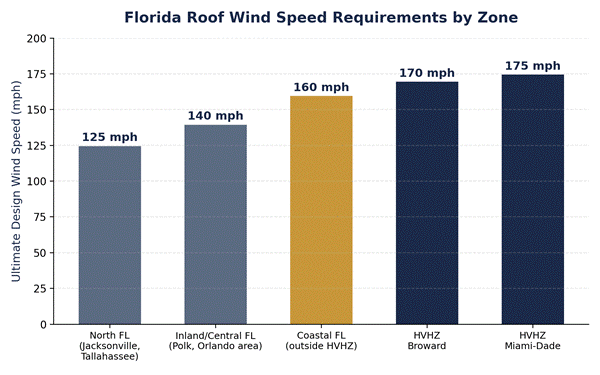
Ultimate design wind speed requirements climb sharply inside the HVHZ.
| Zone | Approximate Area | Design Wind Speed | Product Approval Needed |
| North Florida | Jacksonville, Tallahassee | 115 to 130 mph | Florida Product Approval |
| Inland / Central FL | Polk County, Orlando area | 130 to 140 mph | Florida Product Approval |
| Coastal FL (outside HVHZ) | Most of the Gulf and Atlantic coast | 150 to 160 mph | Florida Product Approval |
| HVHZ | Broward County | 170 mph | Miami-Dade NOA required |
| HVHZ | Miami-Dade County | 175 mph | Miami-Dade NOA required |
A common misconception is that a county outside the HVHZ has a weak roofing code. It doesn’t. A 130 mph rated roof is still built to withstand a strong Category 3 storm, it’s simply a different, less severe standard than what Broward and Miami-Dade require.
What a Miami-Dade NOA Actually Certifies
Every roofing product installed inside the HVHZ, shingles, tile, underlayment, metal panels, even the fasteners, has to carry a Notice of Acceptance issued by Miami-Dade County, or in some cases a statewide Florida Product Approval that specifically covers HVHZ use. The NOA number confirms that the exact product was independently tested for wind uplift resistance and large-missile impact, meaning it was shot with a test projectile simulating wind-borne debris and still held.
This matters at the contract stage, not just the inspection stage. A homeowner is entitled to ask for the NOA numbers of every material being installed and to verify them before signing, because a product that is perfectly legal in Orlando is not automatically legal in Fort Lauderdale.
The Roof Deck Matters as Much as the Shingles
It’s tempting to think of a roof as the visible layer, the shingles or tile on top. Code enforcement treats the deck underneath as equally important, because a wind uplift rating means nothing if the plywood or OSB panel beneath the shingles isn’t fastened to the trusses correctly.
The chart below reflects a pattern seen across post-storm damage assessments in South Florida: deck attachment and edge details fail more often, and more destructively, than the visible roofing material itself.
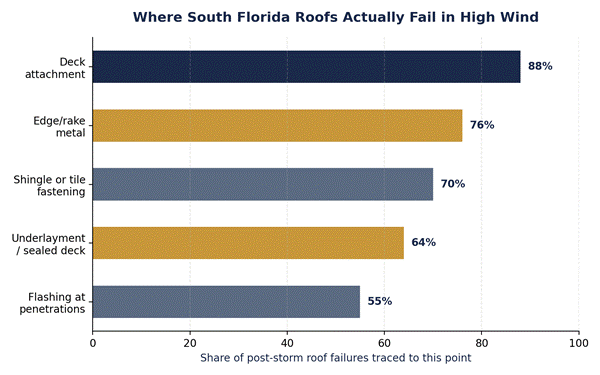
Deck attachment and edge metal are the two most common starting points for wind-driven roof failure.
- Deck fastening pattern: HVHZ requires a tighter nailing schedule than standard code, sometimes called the 6-nail pattern for asphalt shingle roofs.
- Sealed roof deck (SRD): a secondary water barrier applied over the deck seams, increasingly required or incentivized because it keeps water out even if the top layer is compromised.
- Edge metal and drip edge: the perimeter of the roof takes the highest wind pressure, which is why edge securement has its own fastening requirements separate from the field of the roof.
- Flashing at penetrations: vents, chimneys, and skylights are common leak points when flashing isn’t integrated correctly with the underlayment.
The 25 Percent Rule and Why It Surprises Homeowners
Under the Florida Existing Building Code, if a re-roofing project involves repairing or replacing more than 25 percent of the roof area, the entire roof can be required to come up to current code, not just the repaired section. This is often called the 25 percent rule, and it was reinforced statewide by Senate Bill 4D.
For a homeowner who assumed they were paying for a patch, this rule can change the scope of the project significantly. It exists because a roof is a single connected system: bringing one section up to modern wind resistance while leaving the rest at an older, weaker standard creates a mismatched system that can fail at the seam between old and new during a storm.
How Roofing Code Compliance Affects Insurance
Florida’s wind mitigation inspection form documents the specific construction features of a roof, deck attachment method, roof shape, secondary water barrier, opening protection, and insurers use that form to calculate windstorm premium credits. A roof built and documented to current HVHZ standards typically qualifies for meaningfully better credits than an older roof with the same shingles but no documentation of how it was actually attached.
This is one of the most overlooked parts of a reroof: the paperwork proving code compliance can be worth as much to a homeowner over time as the roofing material itself.
Frequently Asked Questions
Is my home automatically in the HVHZ if I live in South Florida?
Only Broward and Miami-Dade counties are officially designated High-Velocity Hurricane Zone. Palm Beach, Martin, and St. Lucie counties are in a separate wind-borne debris region with strong but slightly different requirements. Your local building department can confirm your exact zone and applicable wind speed.
Does a metal roof automatically meet HVHZ requirements?
No. Metal roofing has to carry its own Miami-Dade NOA or approved HVHZ product listing just like any other material. Not every metal roofing system sold in the United States is approved for HVHZ installation.
Can I install a ductless range hood or does that relate to roofing?
That’s a kitchen ventilation question rather than a roofing one, but it’s a good example of how Florida code treats every exterior penetration and system with the same level of scrutiny. If you’re planning a kitchen remodel alongside roof work, ask your contractor how the two permits interact.
What triggers a roof inspection during construction?
Most HVHZ jurisdictions require at least a dry-in inspection, confirming the deck and underlayment are properly installed and sealed, before the final roofing material goes on, plus a final inspection once the job is complete.
Do I need a permit for roof repairs, or only full replacements?
Permit requirements are typically triggered by the scope of work rather than whether it’s called a repair or replacement. A local building department can confirm what specific work requires a permit in your jurisdiction.
The Bottom Line
Florida’s roofing code exists because the state learned, at enormous cost, what happens when it doesn’t. Wind uplift ratings, HVHZ product approvals, and deck attachment standards aren’t paperwork for its own sake, they’re the difference between a roof that performs in a hurricane and one that doesn’t. Whether you’re planning a full reroof or trying to understand what your existing roof is actually rated for, working with a team that treats HVHZ compliance as a baseline, not an upsell, protects both the home and the people inside it.
Have questions about what your roof is rated for or what a South Florida reroof involves? Contact Top Construction and Design at (954) 318-2322 or visit our roofing services page to talk through your project.

