
Quick Answer
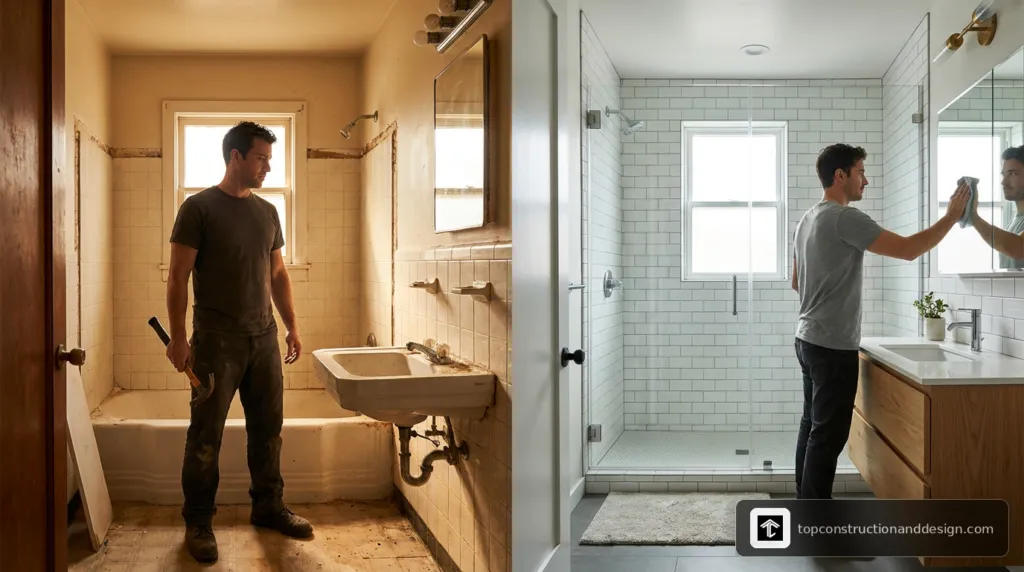
Bathroom remodel before and after photos are most useful for evaluating layout, storage, tile scale, lighting, and accessibility changes when shot from the same camera angle and scale. They cannot show waterproofing quality, plumbing condition, permitting compliance, or true project cost, which is why photos should guide inspiration, not final decisions.
Here’s a number that surprises most homeowners: the median bathroom renovation now costs $15,000, up from $13,000 just a year earlier, while the highest-spending 10% of projects reach roughly $75,000. Yet almost none of that spending shows up in a photo. Bathroom remodel before and after photos can make a dated, cramped space look like a spa in two images, but the dollars that matter most, waterproofing membranes, subfloor repairs, ventilation upgrades, are invisible once the tile goes up.
That gap between what you see and what you’re actually paying for is exactly why before and after photos deserve a closer, more critical look. Used correctly, they’re one of the best decision-making tools available. Used carelessly, they can set expectations that have nothing to do with your home’s actual condition or budget.
Why Do Before and After Photos Matter So Much in 2026?
Bathroom remodel before and after photos work because they translate abstract ideas, “open it up,” “make it feel bigger,” into something concrete. A homeowner staring at a 1990s tub-shower combo often can’t picture a curbless walk-in shower until they see one in a room with similar dimensions.
This matters more in 2026 because bathroom projects have grown more ambitious. Homeowners aren’t just swapping fixtures; they’re reconfiguring layouts, enlarging showers, and planning for long-term accessibility. Photos help bridge the gap between a contractor’s verbal description and a homeowner’s mental image, which is precisely the kind of visual proof that reduces decision anxiety before a five-figure investment.
According to a curated collection of before and after tile renovations, the most persuasive transformations share one trait: they resist the urge to stage dramatic angles that exaggerate the change. Consistency builds trust; trickery erodes it.
What Do Strong Before and After Photos Actually Reveal?
The best bathroom remodel before and after photos are shot from the same camera position, height, and lens angle in both images. That consistency lets you judge real spatial change rather than a photographer’s trick. When done right, these photo pairs typically reveal:
- Spatial efficiency: whether a bulky corner tub was replaced by a wider shower, or a toilet was relocated to improve the entry sightline.
- Storage gains: wall-hung vanities that expose more floor area, or recessed medicine cabinets replacing surface-mounted ones.
- Tile and fixture scale: whether larger-format tile was used to make a small room read as more open, a trend well documented in recent bathroom remodel design roundups.
- Lighting changes: added sconces, skylights, or layered lighting that photos capture more honestly than written descriptions.
- Accessibility features: grab bars, curbless entries, and bench seating that are easy to spot once you know to look for them.
Photo pairs also help homeowners evaluate finish coordination, whether the countertop, hardware, and tile tones work together as a cohesive palette rather than a collection of individually nice choices.
What Can’t Before and After Photos Tell You?
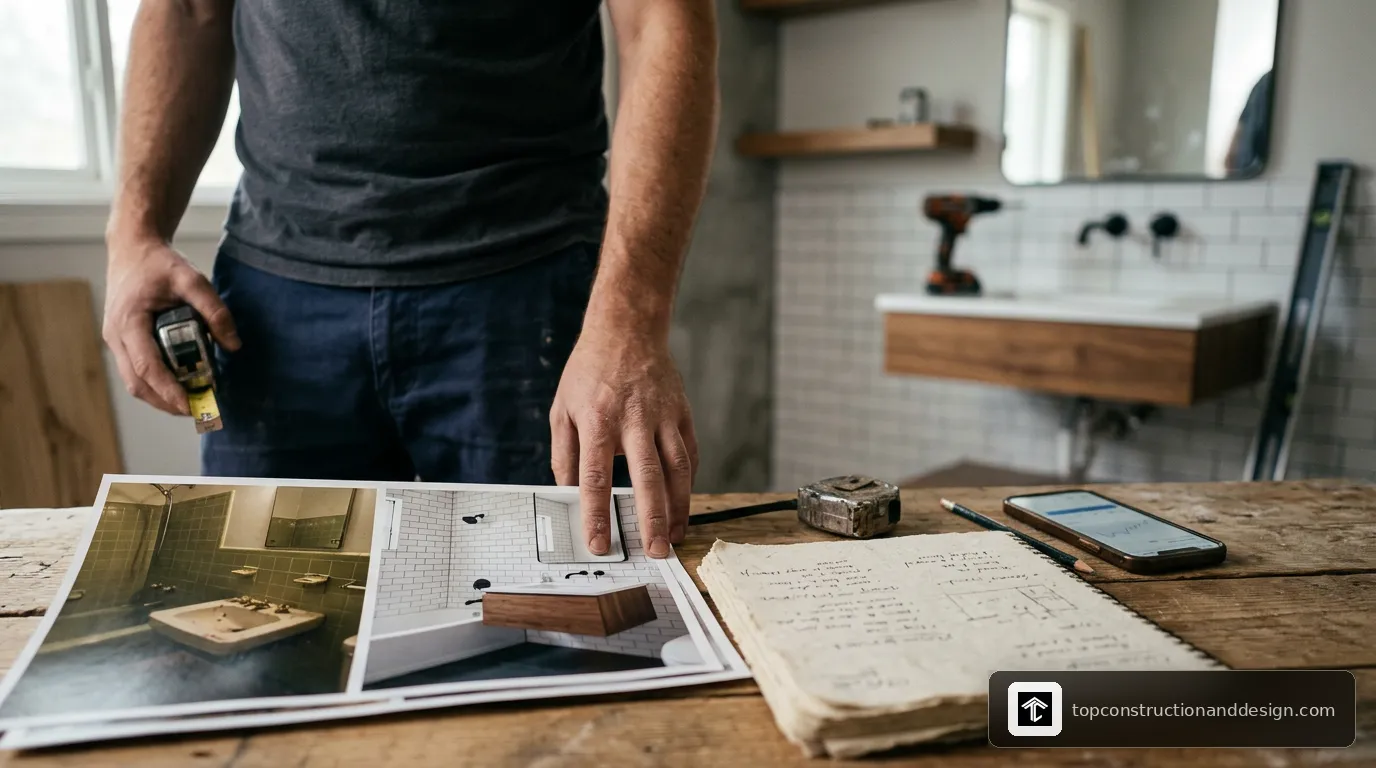
This is the section most galleries skip, and it’s the most important one. A photo cannot show you what’s behind the wall. Waterproofing quality, the membrane systems, slope-to-drain accuracy, and moisture barriers that prevent mold and rot, are completely invisible in a finished shot. Two bathrooms can look identical in photos while one was built with a proper vapor barrier and the other wasn’t.
Photos also hide plumbing condition. A remodel that reuses 40-year-old galvanized supply lines behind a brand-new vanity will look just as polished as one with fully updated copper or PEX, until a pipe fails two years later. Similarly, permitting status never appears in a photo. An unpermitted shower reconfiguration can create real problems at resale, regardless of how good it looks.
Finally, photos rarely reveal true cost. A gallery image of a wet room or a 72-inch double vanity doesn’t disclose whether the footprint was expanded, whether structural work was needed, or what region the project was built in, all major cost drivers.
What Do 2026 Bathroom Trends Reveal About These Transformations?
Looking at a large sample of recent projects helps explain what’s actually changing behind these photos. The NKBA’s 2026 bath trends report and related industry data point to a clear shift: bathrooms are becoming larger, more accessible, and more wellness-focused, even when the footprint itself stays the same.
Enlarged the shower: 49%
Removed the bathtub entirely: 25%
Converted to a wet room: ~16%
Chose vanities wider than 72 inches: 1 in 5
Added rainfall showerheads: 19%
Added waterfall faucets: 19%
Added grab bars: 61%
Installed nonslip flooring: 55%
Added low-curb showers: 52%
Refreshed overall aesthetic: 81%
Prioritized shower over tub: 55%
Expect larger footprints ahead: 72%
These figures, drawn from industry survey data rather than universal averages, explain a visual pattern you’ll notice across most quality bathroom remodel before and after galleries: the tub is disappearing, the shower is growing, and the vanity is getting wider and more functional. A separate 2026 survey found that 77% of tub-to-shower conversion plans included or considered accessibility features like benches, grab bars, or low thresholds, reinforcing that this isn’t a cosmetic fad but a long-term planning shift.
How Should You Evaluate a Contractor’s Photo Gallery?
Not all before and after galleries are created equal. Some are curated to flatter; others are documentary and honest. Here’s how to tell the difference when you’re researching a bathroom remodel contractor.
- Check the camera angle. If the “after” shot is taken from a lower angle or wider lens than the “before,” the room will look artificially larger.
- Look for matching lighting conditions. A dim, yellow-toned “before” photo next to a bright, daylight “after” photo exaggerates the transformation.
- Ask about the project behind the photo. Request details on permitting, waterproofing method, and whether the footprint changed, as outlined in general renovation guidance from Houzz’s bathroom remodeling cost breakdown.
- Look for a variety of bathroom sizes and budgets. A gallery full of only high-end primary suites doesn’t tell you much if your bathroom is a small hall bath.
- Notice whether accessibility and aging-in-place features appear. Given that 68% of 2026 renovations addressed special needs, a gallery with zero grab bars or curbless showers may be behind current standards.
Real-world case studies, like the renovation walkthrough documented in this University of Dayton bathroom remodel blog post, are valuable precisely because they describe the process, not just the finished look, giving homeowners a fuller picture of what the transformation actually involved.
How Much Do These Transformations Actually Cost?
This is where photos and reality diverge the most. A stunning before and after pair might represent a $12,000 refresh or an $80,000 structural overhaul, and you often can’t tell which from the image alone. Pricing varies enormously based on scope, materials, layout changes, structural or plumbing work, and regional labor rates.
| Project Scope | What It Typically Involves |
|---|---|
| Cosmetic refresh | New fixtures, paint, lighting, and vanity within the existing layout |
| Mid-range remodel | New tile, enlarged shower, double vanity, upgraded plumbing fixtures |
| Full gut renovation | Layout changes, new waterproofing, structural or electrical updates, premium finishes |
Because median spending now sits at $15,000 while top-tier projects reach approximately $75,000, it’s worth treating every impressive photo as a starting conversation rather than a price quote. The only reliable way to know what a comparable transformation would cost in your home is a custom, on-site quote that accounts for your plumbing, structure, and finish selections.
Key Takeaways
- Bathroom remodel before and after photos are most trustworthy when shot from a matching camera angle, height, and lighting condition.
- Photos reveal layout, storage, tile scale, and accessibility changes, but not waterproofing quality, plumbing condition, or permitting status.
- Median bathroom renovation spending reached $15,000 in recent reporting, with top-tier projects reaching roughly $75,000.
- 49% of recent renovations enlarged the shower, and 25% removed the bathtub entirely, a pattern visible across most current galleries.
- 68% of homeowners addressed special needs features like grab bars, nonslip flooring, and curbless showers.
- A strong gallery includes a range of bathroom sizes, budgets, and accessibility features, not just high-end showcase projects.
- Always pair photo research with a detailed, custom quote rather than assuming a similar look means a similar price.
People Also Ask
What makes a bathroom before and after photo misleading?
Mismatched camera angles, wide-angle lenses used only in the “after” shot, and inconsistent lighting can make a room appear dramatically larger or brighter than the actual change achieved.
Do before and after photos show the real cost of a remodel?
No. Photos cannot show hidden costs like waterproofing, plumbing updates, permitting fees, or structural work, which often account for a large share of total project spending.
Why are more homeowners removing bathtubs in 2026?
About 25% of homeowners removed their bathtub in recent renovations, often to enlarge the shower, reflecting a broader shift where 55% of homeowners now consider a larger shower more important than a tub.
How can I use before and after photos to plan my own remodel?
Look for photos of bathrooms with a similar size and layout to yours, note which structural changes were made, and ask the contractor for project details behind the photo, including scope, cost range, and permitting.
What accessibility features show up most often in recent remodels?
Grab bars appeared in 61% of renovations addressing special needs, followed by nonslip flooring at 55%, low-curb showers at 52%, additional lighting at 31%, and curbless showers at 28%.
Frequently Asked Questions
What should I look for in bathroom remodel before and after photos?+
Check that both photos were shot from the same camera position, height, and lighting conditions. Focus on layout changes, storage, tile scale, and accessibility features rather than overall polish alone.
Can before and after photos tell me if the work was done correctly?+
No. Photos cannot reveal waterproofing quality, plumbing condition, or whether permits were pulled. These factors require asking the contractor directly or reviewing project documentation.
How much does a bathroom remodel typically cost in 2026?+
Recent reporting shows median spending around $15,000, with top-tier projects reaching approximately $75,000. Pricing varies widely based on scope, materials, layout changes, and your specific project needs, so a custom quote is the most accurate way to budget.
Why do so many 2026 remodels enlarge the shower instead of the tub?+
Nearly half of homeowners, 49%, enlarged their shower in recent renovations, and 25% removed the bathtub entirely. This reflects a broader preference for wellness-oriented, accessible bathing spaces over traditional tubs.
Do before and after photos keep the same footprint or expand the room?+
Most do not expand the footprint. About 82% of recent renovations kept the existing bathroom footprint while still enlarging showers and vanities within that same space.
Should I ask a contractor for more detail behind their gallery photos?+
Yes. Ask about the scope of work, waterproofing method, whether permits were obtained, and the general cost range for a comparable project to get the full picture beyond what the photo shows.
Bathroom remodel before and after photos remain one of the most powerful tools for envisioning what’s possible in your own home, but they’re a starting point, not a substitute for an honest, detailed conversation about your bathroom’s specific layout, condition, and goals. If you’ve been collecting inspiration photos and want to know what a comparable transformation would actually involve and cost in your home, reach out for a custom consultation built around your space, not someone else’s.

