
Quick Answer
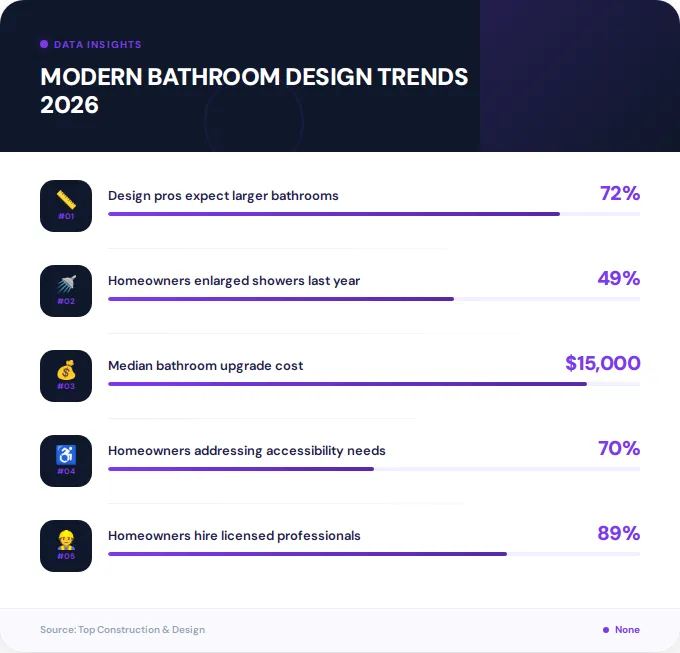
Modern bathroom design trends 2026 center on larger showers, universal accessibility, layered lighting, and wellness-driven layouts rather than purely decorative upgrades. National data shows 72% of design professionals expect bathroom footprints to grow and 89% of homeowners now hire at least one licensed professional to manage waterproofing, electrical, and structural work safely. A good contractor builds these trends on a foundation of code compliance, proper permitting, and honest scope-setting, not just finish selection.
What’s Driving Bathroom Design Trends in 2026?
Here’s a number that surprises most homeowners: 72% of design professionals surveyed by the National Kitchen and Bath Association expect bathroom footprints to increase in the coming year. That is not a cosmetic shift. It signals that bathrooms are being reimagined as functional, wellness-oriented rooms rather than small, purely utilitarian spaces squeezed into a floor plan.
Modern bathroom design trends 2026 reflect a broader change in how people use these rooms. According to the NKBA’s 2026 bath trends report, 89% of homeowners now rank space allocation as a top planning priority, ahead of finish selection or color palette. That means smart circulation, adequate storage, and seating zones are being designed before anyone picks a tile.
This shift also shows up in national remodeling spending. Recent industry data puts the median cost of bathroom upgrades at $15,000, with major remodels reaching a median of $25,000, and the most ambitious primary-bath projects approaching $70,000. Pricing varies widely based on scope, structural changes, materials, and local labor costs, which is why any serious estimate should come after an in-person assessment rather than a generic online calculator.
Why Are Showers Replacing Tubs as the Main Feature?
The oversized soaking tub that dominated bathroom design a decade ago is losing ground. 49% of renovating homeowners enlarged their shower in the past year, a jump of 10 percentage points year over year, according to data reported by Houzz’s 2026 bathroom remodeling trends research. Meanwhile, 55% of design experts say enlarging the shower matters more to their clients than adding a soaking tub at all.
This doesn’t mean tubs are disappearing entirely. It means contractors are asking better questions before committing square footage to a feature that may go unused. A tub still makes sense for households with young children or specific relaxation routines, but it should be justified by how the space will actually be lived in, not by resale assumptions that no longer hold up.
| Shower Feature | Adoption Rate | Why It Matters |
|---|---|---|
| Low-curb entry | 47% overall, 55% in aging-in-place projects | Reduces trip hazards without looking clinical |
| Curbless entry | 32% of aging-in-place remodels | Requires precise waterproofing and slope work |
| Rainfall/waterfall fixtures | 19%, up 6 points YoY | Adds hospitality feel but increases water use |

What Does Universal Design Mean for Your Remodel?
Accessibility is no longer a retrofit conversation reserved for emergencies. More than 70% of homeowners are now addressing current or future special needs in their bathroom remodels, and of those planning ahead, more than half expect those needs to arrive at least five years in the future. That is a meaningful change: people are building for their future selves, not just their current ones.
The specific features being integrated tell the story. Grab bars appear in 63% of aging-in-place projects, nonslip flooring in 56%, low-curb showers in 55%, additional lighting in 33%, and ADA-compliant toilets in 24%. Coverage from the Chicago Agent Magazine review of the 2026 Houzz bathroom study confirms this is one of the fastest-growing categories in residential remodeling.
A good contractor treats grab bar blocking, reinforced wall framing, and curbless shower pans as standard planning steps, built in from day one, rather than something bolted on later. That distinction alone separates a durable remodel from one that needs costly rework in five or ten years.
“The bathrooms getting the best long-term reviews aren’t the ones with the flashiest tile. They’re the ones where the waterproofing was done right, the lighting was layered properly, and nothing has to be redone in year three. Trends come and go, but a dry wall cavity and a properly sloped shower pan never go out of style.”
How Important Is Lighting and Wellness Design in 2026?
91% of NKBA experts identify lighting quality as a top design priority for 2026, ahead of countertop material, cabinetry style, or even layout in some surveys. This reflects a move away from a single overhead fixture toward layered lighting: ambient light for overall illumination, task lighting at mirrors and vanities, accent lighting to highlight niches or shelving, and soft night lighting for safe nighttime use.
Wellness is the broader theme tying everything together. 77% of homeowners say they want hotel- or resort-inspired bathrooms, and 50% report spending more time in the bathroom after a renovation is complete. Findings reported by KBB’s coverage of the 2026 Houzz bathroom trends study show that cleanliness (76%), spacious showers (71%), and organized storage (67%) contribute more to a relaxing bathroom experience than decorative elements alone.
In practice, this means a contractor who understands 2026 trends will spend as much time discussing ventilation, exhaust fan sizing, and closet or linen storage as they do discussing tile samples. A beautiful room that stays damp or disorganized isn’t a wellness space, it’s a maintenance problem waiting to happen.
Footprint expected to grow: 72%
Professional hired for project: 89%
Low-curb entries: 47%
Curbless in aging-in-place: 32%
Lighting as top priority: 91%
More time spent post-remodel: 50%
What Does a Good Contractor Do Differently?
Trend knowledge is only useful if it’s paired with sound construction practice. A contractor who understands modern bathroom design trends 2026 doesn’t just know that curbless showers are popular. They know how to build the sloped substrate, select the correct waterproofing membrane, and verify the drain placement meets local plumbing code before a single tile is set.
Research from Fixr’s analysis of current bathroom design trends and the National Association of Realtors’ breakdown of outgoing and incoming bathroom styles both emphasize the same point: trends that look good in photos but ignore ventilation, moisture control, or structural support create problems that surface months or years later.
- Scopes the project honestly, including hidden issues like subfloor rot or outdated electrical that only appear once demolition begins.
- Pulls proper permits for plumbing, electrical, and structural changes rather than treating permitting as optional paperwork.
- Explains trade-offs between a curbless shower’s accessibility benefits and its higher waterproofing cost and complexity.
- Coordinates trades so electrical rough-in for layered lighting happens before drywall, not after.
- Documents the work with photos of waterproofing and rough-in stages, giving homeowners a record for future resale or insurance needs.
How Does Licensing, Safety, and Warranty Protect Homeowners?
Bathrooms combine water, electricity, and structural loads in a small footprint, which is exactly why 89% of homeowners now hire at least one licensed professional for their remodel, up 5 percentage points year over year. That increase isn’t a coincidence. It reflects growing awareness that DIY shortcuts in a wet room can lead to mold, rot, or electrical hazards that are far more expensive to fix than the original remodel.
A trustworthy contractor should be able to clearly explain their license status, carry general liability and workers’ compensation insurance, and provide a written warranty covering both labor and materials. If a contractor hesitates to put any of this in writing, that hesitation is itself useful information.
Good process also means transparent sequencing: demolition and inspection, rough-in of plumbing and electrical, waterproofing and inspection sign-off, then finish work. Each stage should be visible to the homeowner, with photos or walkthroughs at key milestones, not just a single reveal at the end.
What Should You Expect to Budget in 2026?
Bathroom remodel costs vary significantly depending on scope, materials, layout changes, and regional labor rates. National data shows a median of $15,000 for general bathroom upgrades, a median of $25,000 for major remodels involving layout changes or structural work, and the largest, most feature-rich primary-bath projects climbing toward $70,000.
These figures should be treated as a general reference point, not a quote. A small powder room refresh and a primary bath expansion with a curbless shower, heated flooring, and custom cabinetry sit at opposite ends of a very wide range, typically $10,000 to $70,000 or more depending on finish quality and the extent of structural work involved. Pricing varies based on your specific project, and the only way to get an accurate number is a detailed in-home assessment.
According to the Pro Builder report on 2026 bathroom trends and future planning, homeowners who invest in accessibility and quality waterproofing upfront tend to avoid the far higher cost of a secondary renovation driven by failure or changing needs later on.
- 72% of design professionals expect bathroom footprints to grow in 2026, shifting focus toward layout and storage planning.
- Showers are displacing oversized tubs, with 49% of homeowners enlarging showers and 55% of experts prioritizing shower space over tub space.
- Universal design is proactive, not reactive: over 70% of homeowners are planning for current or future accessibility needs.
- Lighting quality is now a top priority for 91% of design experts, pointing toward layered ambient, task, and accent lighting.
- 89% of homeowners hire licensed professionals, reflecting growing awareness of the risks in unsupervised wet-area construction.
- Budgets vary enormously by scope, from simple updates to full primary-bath renovations approaching $70,000, so custom quotes matter more than national averages.
People Also Ask
What bathroom trends are going out of style in 2026?
Oversized soaking tubs rarely used by households, heavily ornate finishes, and single overhead lighting fixtures are declining in favor of larger showers, layered lighting, and simplified natural palettes.
Are curbless showers worth the extra cost?
For many households, yes, especially when planning for long-term accessibility, since curbless showers reduce fall risk and suit multiple life stages. They do require more precise waterproofing and sloped substrate work, which can add to labor cost.
How much does a modern bathroom remodel cost in 2026?
Costs vary widely, with national medians around $15,000 for upgrades and $25,000 for major remodels, while large-scope primary-bath projects can approach $70,000 depending on materials and layout changes.
Do I need a licensed contractor for a bathroom remodel?
Yes, especially for work involving plumbing, electrical, or structural changes, since improper work in a wet environment can lead to mold, leaks, or safety hazards. Licensed contractors also carry insurance and typically provide warranties that protect the homeowner.
Frequently Asked Questions
What is the biggest bathroom trend for 2026?+
The biggest trend is larger, more functional showers replacing oversized tubs, supported by 72% of design professionals expecting overall bathroom footprints to grow in 2026.
Is universal design only for elderly homeowners?+
No. Over 70% of homeowners incorporating accessibility features are planning ahead, with many expecting those needs at least five years in the future, meaning it benefits households of all ages and situations.
Why is lighting such a high priority in modern bathroom design?+
Lighting affects both function and wellness, which is why 91% of design experts rank it as a top priority. Layered lighting, ambient, task, accent, and night lighting, creates a safer and more comfortable space than a single fixture.
How long does a modern bathroom remodel take?+
Timelines depend on scope, but most full bathroom remodels involving layout changes take several weeks from demolition through final inspection. A licensed contractor can give a project-specific schedule after assessing structural, plumbing, and electrical conditions.
What should be included in a contractor’s warranty?+
A solid warranty should cover both labor and materials, specify the duration of coverage, and clearly state what triggers a service call versus what falls under normal wear and tear. Always get warranty terms in writing before work begins.
Are waterfall showerheads and rainfall fixtures practical?+
They can be, and adoption rose to 19% of remodels, up 6 percentage points year over year, but homeowners should weigh water efficiency and cleaning requirements against the hospitality-style appeal before committing.

